Sunday, April 19, 2020
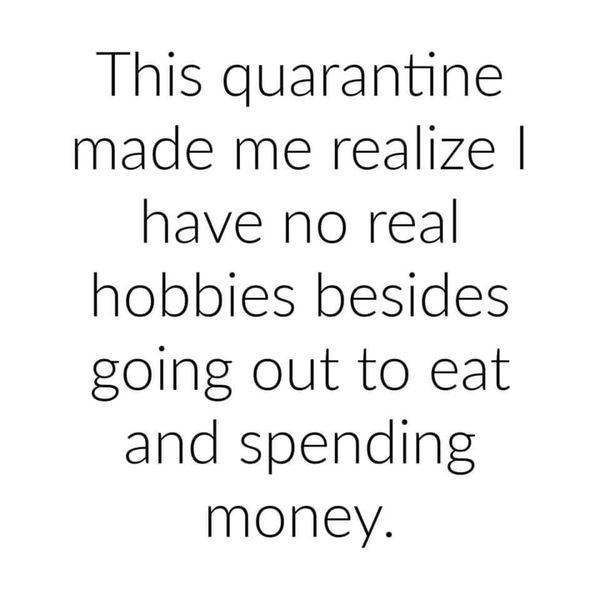
I have no real hobbies besides going out to eat and spending money ...






 A NASA software engineer for 23 years (retired), Silicon Valley software engineer for 36+years, Egyptology hobbyist and ARCE-NC board of directors member for more than 25 years, reporter and copy editor for the Kansas City Star and Louisville Courier-Journal for 6 years. Phi Beta Kappa, Phi Kappa Phi, Kappa Tau Alpha, Heritage Registry of Who's Who. I favor open source development, Linux, net neutrality, medical care as a right and not a privilege, the ACLU, freedom of religion, separation of church and state, freedom of speech.
Re: lightning in a jar disclaimer
I am informed by a recipient that the previous email under this heading listed a number of stats that he says are mostly wrong. I won't be checking them myself, but I offer my apologies if they are, in fact, mostly wrong.
Glenn
On 04/19/2020 02:34 PM, Glenn Meyer wrote:
FYI, I am informed that the previous email under this heading listed a number of stats that he says are mostly wrong. Just FYI, I won't be checking them myself, but I offer my apologies if they are, in fact, mostly wrong.
Glenn
-- Sent from my Linux system.
-- Sent from my Linux system.
A NASA software engineer for 23 years (retired), Silicon Valley software engineer for 36+years, Egyptology hobbyist and ARCE-NC board of directors member for more than 25 years, reporter and copy editor for the Kansas City Star and Louisville Courier-Journal for 6 years. Phi Beta Kappa, Phi Kappa Phi, Kappa Tau Alpha, Heritage Registry of Who's Who. I favor open source development, Linux, net neutrality, medical care as a right and not a privilege, the ACLU, freedom of religion, separation of church and state, freedom of speech.
Re: lightning in a jar disclaimer
Glenn
-- Sent from my Linux system.
A NASA software engineer for 23 years (retired), Silicon Valley software engineer for 36+years, Egyptology hobbyist and ARCE-NC board of directors member for more than 25 years, reporter and copy editor for the Kansas City Star and Louisville Courier-Journal for 6 years. Phi Beta Kappa, Phi Kappa Phi, Kappa Tau Alpha, Heritage Registry of Who's Who. I favor open source development, Linux, net neutrality, medical care as a right and not a privilege, the ACLU, freedom of religion, separation of church and state, freedom of speech.
"A clear conscience is the sign of a bad memory", and other paraprosdokians.
or unexpected and is frequently humorous. (Winston Churchill loved them).
1. Where there's a will, I want to be in it
2. The last thing I want to do is hurt you ... but it's still on my list.
3. Since light travels faster than sound, some people appear bright until you hear them speak.
4. If I agreed with you, we'd both be wrong.
5. We never really grow up -- we only learn how to act in public.
6. War does not determine who is right, only who is left.
7. Knowledge is knowing a tomato is a fruit. Wisdom is not putting it in a fruit salad.
8. To steal ideas from one person is plagiarism. To steal from many is research.
9. I didn't say it was your fault, I said I was blaming you.
10. In filling out an application, where it says, "In case of emergency, notify..." I answered "a doctor."
11. Women will never be equal to men until they can walk down the street with a bald head and a beer gut, and still think they are sexy.
12. You do not need a parachute to skydive. You only need a parachute to skydive twice.
13. I used to be indecisive, but now I'm not so sure.
14. To be sure of hitting the target, shoot first and call whatever you hit the target.
15. Going to church doesn't make you a Christian, any more than standing in a garage makes you a car.
16. You're never too old to learn something stupid.
17. I'm supposed to respect my elders, but it's getting harder and harder for me to find one now.
18. They begin the evening news with 'Good Evening,' then proceed to tell you why it isn't.
19. Behind every successful man is his woman. Behind the fall of a successful man is usually another woman.
20. A clear conscience is the sign of a bad memory.
21. Nostalgia isn't what it used to be. Nor is there any future in it.
22. Change is inevitable, except from a vending machine.
A NASA software engineer for 23 years (retired), Silicon Valley software engineer for 36+years, Egyptology hobbyist and ARCE-NC board of directors member for more than 25 years, reporter and copy editor for the Kansas City Star and Louisville Courier-Journal for 6 years. Phi Beta Kappa, Phi Kappa Phi, Kappa Tau Alpha, Heritage Registry of Who's Who. I favor open source development, Linux, net neutrality, medical care as a right and not a privilege, the ACLU, freedom of religion, separation of church and state, freedom of speech.
With Broad, Random Tests for Antibodies, Germany Seeks Path Out of Lockdown - The New York Times

With Broad, Random Tests for Antibodies, Germany Seeks Path Out of Lockdown
It was the first large Western democracy to contain the spread of the coronavirus and is now the first to methodically go about reopening its economy. Others are watching.
Taking a blood sample as part of random sampling for antibodies to the coronavirus.Credit...
Photographs by Laetitia Vancon
- Published April 18, 2020Updated April 19, 2020, 12:46 a.m. ET
BERLIN — Felix Germann was not expecting anyone when his doorbell rang last week. Outside was a doctor who looked like she had just stepped out of an operating theater, green scrubs, face mask and all — and a policeman.
"I didn't do it!" Mr. Germann said, throwing up his hands, and everybody laughed.
The unusual visitors had come with an unusual proposal: Would he allow them to test his blood for Covid-19 antibodies? Every month? For a year? Starting next week?
He would be helping to further the science that would ultimately allow for a controlled lifting of social and economic restrictions and save lives.
"Of course I said yes," said Mr. Germann, a 41-year-old project manager at a media company. "I want to help. This is a collective crisis. The government is doing what it can. Everyone needs to do their bit."
Advertisement
With that, Mr. Germann and his girlfriend joined 3,000 households chosen at random in Munich for an ambitious study whose central aim is to understand how many people — even those with no symptoms — have already had the virus, a key variable to make decisions about public life in a pandemic.
The study is part of an aggressive approach to combat the virus in a comprehensive way that has made Germany a leader among Western nations figuring out how to control the contagion while returning to something resembling normal life.
Other nations, including the United States, are still struggling to test for infections. But Germany is doing that and more. It is aiming to sample the entire population for antibodies in coming months, hoping to gain valuable insight into how deeply the virus has penetrated the society at large, how deadly it really is, and whether immunity might be developing.


The government hopes to use the findings to unravel a riddle that will allow Germany to move securely into the next phase of the pandemic: Which of the far-reaching social and economic restrictions that have slowed the virus are most effective and which can be safely lifted?
The same questions are being asked around the world. Other countries like Iceland and South Korea have tested broadly for infections, or combined testing with digital tracking to undercut the spread of the virus.
In hard-hit Italy, antibody tests — and the potential of "immunity licenses" — have lingered over a national debate over how and when to reopen the country. Regional presidents have turned to serological tests as a way to better chart infections but also to get a sense of which workers might have the desired antibodies to possibly provide protection and return to work.
But even the best laid plans can go awry; Singapore attempted to reopen only to have the virus re-emerge.
In the United States, President Trump is in a hurry to restart the economy in an election year, but experts warn that much wider testing is needed to open societies safely.
Both Britain and the United States, where some of the first tests were flawed, virtually forfeited the notion of widespread testing early in their outbreaks and have since had to ration tests in places as they scramble to catch up. In Italy, one of the worst hit countries in the world, the central government and regional leaders sparred over how widely to test.
Germany, which produces most of its own high-quality test kits, is already testing on a greater scale than most — 120,000 a day and growing in a nation of 83 million.
Chancellor Angela Merkel, a trained scientist, said this week that the aim was nothing less than tracing "every infection chain."
That high level of testing has helped her country slow the spread of the virus and keep the number of deaths relatively low. More people in Germany now recover from the virus every day than are infected by it. Every 10 people infected with the virus now pass it to seven others — a sharp decline in the infection rate for a virus that has spread exponentially.
Even so, Ms. Merkel, too, has had her stumbles in dealing with the virus.
Germany has been criticized for failing to offer forceful leadership to the European Union at a moment of profound crisis. The generosity and solidarity on such striking display inside of Europe's largest and richest economy have been missing in Germany's response to poorer European nations in the south, which were hit hardest by the virus.


At home, however, the chancellor's mixture of calm reassurance and clear-eyed realism — as well as her ability to understand the science and explain it to citizens — has been widely praised and encouraged Germans to follow social distancing rules. Her approval ratings are now higher than 80 percent.
That broad confidence in government has given Germany a tremendous advantage. It is much of the reason a knock on the door by a police officer and strangers dressed like aliens asking for blood can engender good will rather than alarm, even in a country where past authoritarian governments have left citizens protective of their privacy.
Advertisement
The Munich antibody study, run by the Division of Infectious Diseases and Tropical Medicine at Munich University Hospital, and cofinanced by the government of the state of Bavaria, is the biggest of several regional studies being rolled out in various corners of Germany. Still, scientists caution that there is no proof yet that the detection of antibodies signals effective immunity and even if it does, it is not known how long that immunity might last.
Nationally, the Robert Koch Institute, the government's central scientific institution in the field of biomedicine, is testing 5,000 samples from blood banks across the country every two weeks and 2,000 people in four hot spots who are farther along in the cycle of the disease.
Its most ambitious project, aiming to test a nationwide random sample of 15,000 people across the country, is scheduled to begin next month.
"In the free world, Germany is the first country looking into the future," said Prof. Michael Hoelscher, who heads up the Munich study, noting that a number of countries had already asked him for the protocol to be able to replicate it. "We are leading the thinking of what to do next."
Mr. Hoelscher was co-author of what has become a widely influential research paper about how the virus can be transmitted before someone develops symptoms.
"There's no doubt after reading this paper that asymptomatic transmission is occurring," Dr. Anthony Fauci, director of the National Institute for Allergy and Infectious Diseases in the United States, told CNN on Feb. 1, three days after the paper was published. "This study lays the question to rest."
Asymptomatic transmission is what has made containment so difficult because a large number of infections are not detected.


Measuring the number of hidden infections and getting a sense of the true scale of the disease is key to fine-tuning the gradual loosening of restrictions and minimizing income loss and social isolation, scientists say.
"We will have a better idea of the number of undetected infections once we have done these representative studies," said Lothar Wieler, president of the Robert Koch Institute for infectious diseases, which is conducting a number of the antibody tests. "A lot is being done to measure well."
Some interim results have already come out.
In Gangelt, a small town of about 12,000 in northwest Germany, tests of a first group of 500 residents found that 14 percent had antibodies to the virus. Another 2 percent tested positive for the coronavirus, raising hopes that about 15 percent of the local population may already have some degree of immunity.
"The process toward reaching herd immunity has begun," Prof. Hendrik Streeck, director of the Institute of Virology at the University Hospital Bonn, who is leading the study, said in an interim report.
And even if 15 percent of Gangelt has some degree of immunity, levels of immunity are almost certain to be lower elsewhere in the country.
Advertisement
Gangelt was hit early and exceptionally hard by the virus following a carnival event in mid-February that acted as a super spreader. But it may hold valuable insights for places that lag behind as the pandemic runs its course.
The mortality rate in the town, for example, turned out to be 0.37 percent, much lower than the national rate of 3 percent which is calculated based only on detected infections.
The Munich study is expected to be more nuanced in its findings because it follows participants like Mr. Germann for a whole year. In addition to regular blood tests, there will be questions about everything from mental health to income loss.


"We are at a crossroads," said Mr. Hoelscher, the professor. "Are we going the route of loosening more and increasing immunity in the summer to slow the spread of this in the winter and gain more freedom to live public life? Or are we going to try to minimize transmissions until we have a vaccine?" he asked.
"This is a question for politicians, not for scientists," he added. "But politicians need the data to make an informed risk assessment."
Advertisement
Mr. Hoelscher got the idea for the antibody study in the shower. It was March 19, the day before the state of Bavaria announced its lockdown.
"I thought to myself if we're going into lockdown, we need to start working on an exit strategy now," he said.
The next day, he said he wrote a short pitch to the Bavarian government. Six hours later, he had the green light. It took another three weeks until the test kits had arrived, a new lab was opened and teams of medics started fanning out across the city.
Six days after they first rang his doorbell, a doctor and two medical students came back to Mr. Germann's apartment, household number 420 out of 3,000.
They put on disposable protection suits, gloves and goggles and one of them sat down on a plastic stool they had brought along to take a small vial of his blood. Then they removed and bagged their suits, disinfected the stool and any surface they had touched and left. It took all of 10 minutes.
"I was like, wow, it was a perfect choreography," said Mr. Germann. "It's impressive to think they have teams doing this all across the city. And we're only like one month into this."
An interim result of the study could be released as early as June.
Mr. Germann will get his first results already next week. He is curious.
Advertisement
"You kind of wonder, was that last cold I had corona?"

Christopher F. Schuetze contributed reporting from Berlin.
-- Sent from my Linux system.
A NASA software engineer for 23 years (retired), Silicon Valley software engineer for 36+years, Egyptology hobbyist and ARCE-NC board of directors member for more than 25 years, reporter and copy editor for the Kansas City Star and Louisville Courier-Journal for 6 years. Phi Beta Kappa, Phi Kappa Phi, Kappa Tau Alpha, Heritage Registry of Who's Who. I favor open source development, Linux, net neutrality, medical care as a right and not a privilege, the ACLU, freedom of religion, separation of church and state, freedom of speech.
Saturday, April 18, 2020
Fwd: FactCheck.org's Weekly Update
|







 A NASA software engineer for 23 years (retired), Silicon Valley software engineer for 36+years, Egyptology hobbyist and ARCE-NC board of directors member for more than 25 years, reporter and copy editor for the Kansas City Star and Louisville Courier-Journal for 6 years. Phi Beta Kappa, Phi Kappa Phi, Kappa Tau Alpha, Heritage Registry of Who's Who. I favor open source development, Linux, net neutrality, medical care as a right and not a privilege, the ACLU, freedom of religion, separation of church and state, freedom of speech.